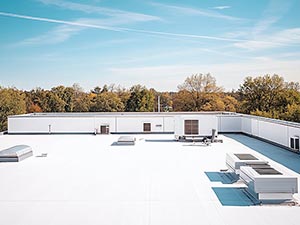
The difference between an elastomeric roof coating that protects a Kalamazoo commercial building for 15 years and one that blisters and peels within two seasons has almost nothing to do with the brand on the bucket. It comes down to how the product behaves when Michigan winter arrives. An elastomeric roof coating in Kalamazoo, MI, that cannot maintain flexibility at below-freezing temperatures will crack under thermal stress and fail at exactly the moment a Michigan winter tests it hardest.
At JM Roofing Solutions, we apply elastomeric coating systems across Kalamazoo and southwest Michigan using products engineered to perform through this climate’s full seasonal range. Call us at (269) 361-8305 to find out what a properly specified system looks like for your building.
This article covers what Michigan winters demand from an elastomeric coating system, what happens to lower-grade products when temperatures drop, and what chemistry and application standards separate a coating that holds from one that fails before its first renewal date.
How Michigan Winters Test Elastomeric Roof Coating
Southwest Michigan delivers a genuinely demanding winter season for commercial roofing coatings. Kalamazoo sees regular below-freezing temperatures from November through March, significant lake-effect snowfall, and freeze-thaw cycling that can repeat multiple times in a single week during shoulder seasons. A coating that was applied in summer and appeared to cure correctly faces its real performance test during those first winter months. Elastomeric coatings are formulated with elongation properties that allow them to stretch and recover as the roof substrate expands and contracts with temperature changes. A quality elastomeric system maintains those properties well below freezing. A cheaper system using lower-grade resin chemistry becomes stiff and brittle in cold weather, losing the elongation that makes it functional. The first hard freeze reveals the difference, and it shows up as surface cracking that opens the membrane beneath to the same moisture exposure the coating was supposed to prevent.
Freeze-Thaw Cycling and Coating Adhesion
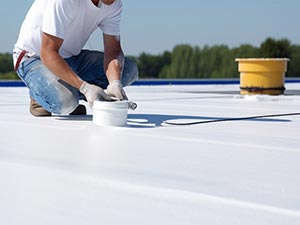
Adhesion failure is the second most common way elastomeric coatings underperform in Michigan, and it is almost always traceable to surface preparation. When a coating is applied over a substrate that was not properly cleaned, dried, and primed, the bond between the coating and the existing membrane is mechanical rather than chemical. That mechanical bond holds adequately through warm weather but is progressively challenged as freeze-thaw cycles create micro-movement between the coating film and the substrate beneath. Each cycle creates a small amount of shear stress at the bond interface.
Over a winter season with repeated cycling, that stress accumulates and the coating begins to lift at edges, laps, and any area where the substrate had any residual contamination or moisture at the time of application. Proper preparation eliminates this failure mode entirely, which is why a contractor who spends adequate time on surface prep before applying product is delivering a fundamentally different result than one who treats prep as time that could be spent coating.
Why Dry Film Thickness Matters
Every professional elastomeric coating system has a specified dry film thickness that must be achieved across the entire roof surface for the product to deliver its rated performance and carry its manufacturer warranty. That thickness requirement exists because thinner applications have lower elongation capacity, lower UV resistance, and lower resistance to the mechanical stresses that Michigan winters create. A contractor who dilutes the product, applies fewer coats than specified, or applies at below-recommended wet film thickness to reduce material cost is delivering a system that will fail earlier than the warranty period under normal Michigan conditions. The dry film thickness specification is not a conservative estimate. It is the minimum below which the coating chemistry does not have enough material mass to function as designed through a full seasonal cycle in southwest Michigan.
Get an Elastomeric Roof Coating
Elastomeric roof coatings must be applied with the right preparation, chemistry, and thickness to perform in demanding climates like Michigan. Without proper surface prep and application standards, coatings can fail early, leading to leaks and reduced system life. When installed correctly, elastomeric coatings provide a seamless, weather-resistant layer that extends roof performance and helps manage long-term maintenance.
JM Roofing Solutions provides elastomeric roof coating services for properties in Kalamazoo, MI. Call (269) 361-8305 to have your roof evaluated and receive the right coating system for long-term performance.
FAQ
Can an elastomeric coating be applied in fall in Kalamazoo before winter arrives?
Fall application is possible in Michigan if ambient temperatures remain consistently above 50 degrees Fahrenheit and adequate cure time is available before the first freeze, which typically limits the window to September and early October.
How is dry film thickness verified during an elastomeric coating application?
Wet film thickness is checked during application using a gauge tool and compared to the product’s specified wet-to-dry conversion rate to confirm the finished dry film will meet the manufacturer’s requirement.
Does an elastomeric coating require the building to be vacated during application in Kalamazoo?
Quality water-based elastomeric systems have minimal odor during application and are generally safe for occupied buildings without special ventilation protocols.
What roof types in Kalamazoo are best suited to elastomeric coating systems?
EPDM, TPO, modified bitumen, and metal roofs are all viable candidates for elastomeric coating when the existing substrate is dry, structurally sound, and well-adhered.