
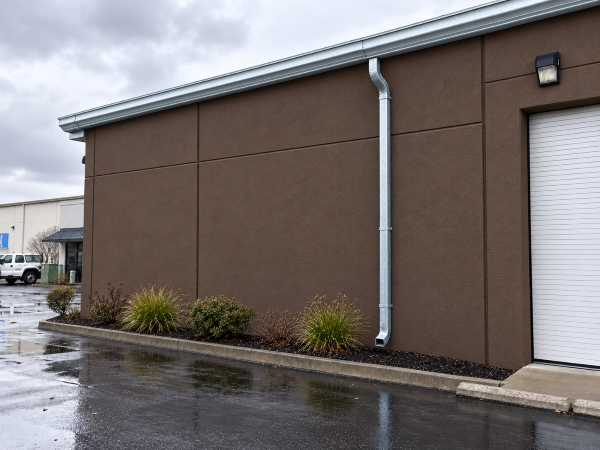
Commercial gutters collect roof runoff at the edge and route it through downspouts to a discharge point. On a Grand Rapids commercial property, performance depends on the roof drainage area, gutter and downspout capacity, attachment, roof-edge details, discharge routing, and seasonal conditions. When overflow, sagging, leakage, or ice-related damage appears, the first step is to identify the cause before deciding between maintenance, repair, partial replacement, or full replacement.
JM Roofing Solutions provides commercial gutters for properties in Michigan, along with repairs and maintenance, acrylic coatings and restoration, spray foam roofing and single-ply roofing including TPO. This guide explains how to judge whether gutters need repair or replacement and what a written scope should cover. For questions about a specific building, call (833) 466-5325.
What Commercial Gutters Do
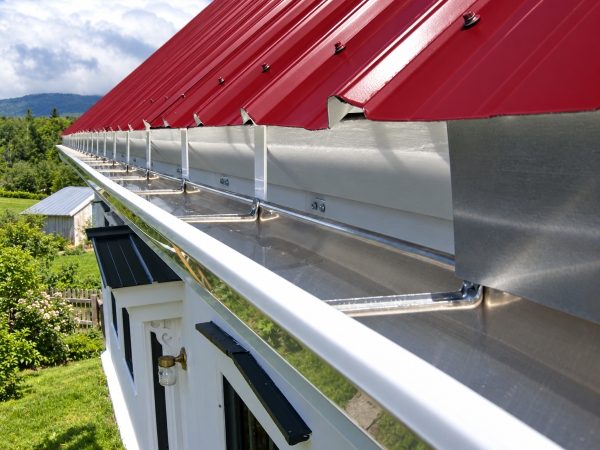
A gutter system collects water at the roof edge and sends it through downspouts to a discharge point. On buildings with sloped or low-slope roofs that drain to the perimeter, gutters are one part of the drainage system. Problems can show up as overflow, water behind the gutter, wet exterior walls, ponding near discharge points, or ice where water is not draining as intended.
Not every commercial building uses gutters. Many flat roofs drain through interior drains or scuppers instead, and our commercial flat roofing in Grand Rapids page explains how flat roof drainage fits into system selection. Where gutters are used, the roof and the gutter need to work together.
Signs Your Commercial Gutters Need Attention
- Water spilling over the edge during rain instead of reaching the downspouts
- Gutters sagging or pulling away from the fascia or roof edge
- Seams or joints that leak or drip
- Rust, corrosion or flaking on metal gutters
- Stains, peeling paint or moisture on exterior walls under the roof edge
- Pooling or erosion near downspout outlets
- Ice buildup at the eave or downspouts in winter
These signs point to a drainage problem, but not always to the same cause. A clogged downspout, a pitch problem and an undersized system can look alike from the ground, so the cause should be identified before a fix is chosen.
Evaluate for localized repair or Compare replacement with any practical localized repair?
Evaluate for localized repair makes sense when the problem is local and the rest of the system is sound. Compare replacement with any practical localized repair becomes worth comparing when deterioration, attachment failure, or capacity problems extend beyond a reliable localized repair. The table below is a screening guide, and the actual decision should rest on an on-site look at the gutters, the roof edge and the downspout layout.
| What you see | Usual direction | What to confirm in writing |
|---|---|---|
| Isolated leak at a seam, joint, or connection | Evaluate for localized repair | Which connection is being repaired, what compatible material or method will be used, and whether adjacent sections remain serviceable |
| Sagging section, loose supports, or changed pitch | Evaluate for localized repair or partial replacement | Condition of the attachment substrate, support spacing, fasteners, and alignment toward the outlets |
| Clogged downspouts or debris buildup | Cleaning or drainage maintenance if the system is otherwise serviceable | Whether the gutter, outlet, downspout, and discharge path are clear and functioning as intended |
| Overflow that continues after cleaning | Capacity, outlet, pitch, or discharge problem to evaluate | Roof drainage area, gutter and downspout capacity, outlet placement, alignment, and discharge path |
| Widespread deterioration or attachment failure along the run | Compare replacement with any practical localized repair | New-system material, capacity, attachment substrate, roof-edge integration, downspout layout, and discharge |
| Ice- or snow-related damage at the eave | Evaluate for localized repair now, review the cause | Roof-edge details, drainage, attachment, and any project-specific winter design requirements |
Fixing gutters also means checking what is behind them. Deterioration at the fascia, edge metal, or other attachment substrate can change the gutter scope, and water entering at the roof edge may require roof repair in addition to gutter work. If you suspect water is entering the roof, our roof leak detection in Grand Rapids page covers how leaks are traced.
What a Written Scope Should Cover
A gutter proposal should be specific enough to compare with another bid. Ask for these items in writing:
- Extent of work: which runs are repaired or replaced, and how many downspouts are included
- Sizing and capacity: the gutter, outlet and downspout sizes, and the roof drainage area or layout used to justify them
- Alignment and outlets: how the run will be aligned toward the outlets and how low spots will be corrected
- Attachment: support type and spacing, fasteners, and the condition of the substrate receiving them
- Roof edge tie-in: how the gutter integrates with edge metal or other drainage details so water reaches the trough as intended
- Discharge: where downspouts empty and how water is kept away from the foundation, walkways and parking areas
- Winter conditions: any project-specific provisions for snow, ice, drainage, and safe access that affect the gutter scope
- Existing damage: what happens if rotten fascia or damaged roof edge is found
- Written warranty terms: if a warranty is offered, what the actual document covers, excludes, and requires for maintenance or repairs
Two bids that look similar can differ in sizing, attachment and how much of the system is actually included, so compare scope before price.
Maintenance Keeps Gutters Working
Gutter maintenance can include removing debris, checking outlets and downspouts, documenting sagging or loose supports, and reviewing discharge areas. There is no single cleaning interval for every building. Timing should reflect nearby trees, roof debris, system layout, prior problems, exposure, and any written maintenance requirements that apply.
Gutter checks fit naturally into a broader roof program. Our roof maintenance in Grand Rapids page describes how drains, scuppers and other drainage components are reviewed during maintenance visits, and our commercial roof repairs in Grand Rapids page covers repairs to the roof itself.
Commercial Gutter Professionals in Grand Rapids
A useful gutter scope starts with the cause of the problem rather than a standard package. For a commercial building in Grand Rapids, that means checking the gutters, downspouts, roof edge and discharge together, then putting the findings and scope in writing. JM Roofing Solutions can be reached at (833) 466-5325 to discuss a commercial gutter project.
Frequently Asked Questions
How often should commercial gutters be cleaned?
There is no single interval for every building. Cleaning frequency should reflect nearby trees, roof debris, drainage layout, prior blockages, exposure, and observed conditions.
Should I repair or replace my commercial gutters?
Localized defects may be repair candidates when the surrounding system remains serviceable. Widespread deterioration, repeated attachment failure, or unresolved capacity problems can justify comparing replacement or a broader redesign.
Why do gutters overflow even when they look clear?
Possible causes include outlet or downspout restrictions, low spots, poor alignment, concentrated runoff, limited capacity, or downstream discharge problems. An on-site evaluation can identify which conditions apply.
Can bad gutters damage the roof?
They can contribute to roof-edge and exterior-wall problems when water is not routed as intended. The gutter, roof edge, attachment substrate, and discharge path should be evaluated together.