Commercial and industrial buildings rarely have simple roof designs. Manufacturing plants, warehouses, medical facilities, and distribution centers often include multiple elevations, rooftop equipment, penetrations, and transitions that complicate traditional roofing systems. At JM Roofing Solutions, we work with businesses across Grand Rapids, MI to install spray foam roofing systems that adapt to these challenges without compromising performance. For commercial spray foam roofing guidance, contact JM Roofing Solutions at (269) 361-8305.
Spray Foam Roofing and Irregular Roof Layouts
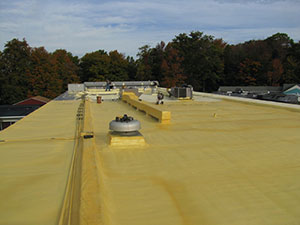
Spray foam roofing is widely used in commercial and industrial applications because it conforms directly to the existing roof surface. Instead of forcing a rigid system over complex layouts, spray foam creates a seamless layer that follows every contour. This adaptability is one of the reasons many facility managers consider it for buildings with non-uniform roof designs.
Before exploring specific design advantages, it helps to understand why irregular roof layouts pose such a challenge in commercial environments. Large buildings evolve over time, with expansions, added equipment, and structural modifications that leave behind uneven surfaces. Spray foam roofing offers a practical way to address these complexities without full structural reconstruction.
Irregular Roof Layouts Are Common
Commercial and industrial roofs are shaped by function, not aesthetics. Rooftop HVAC units, ventilation systems, exhaust stacks, skylights, and drainage components all interrupt the roof surface. Over time, additions and retrofits further complicate the layout.
Common irregular features include:
- Multiple roof elevations and step downs
- High concentrations of penetrations
- Curbs and equipment pads
- Uneven decking from older construction phases
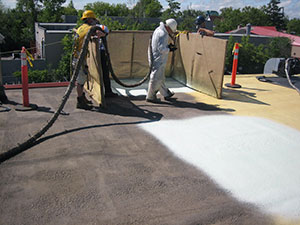
Traditional roofing materials often struggle to seal these areas efficiently. Spray foam roofing is applied as a liquid, allowing it to adapt to these conditions rather than fight against them.
Seamless Coverage Over Complex Surfaces
One of the most significant advantages of spray foam roofing is its seamless nature. Unlike membrane systems that rely on seams, fasteners, or overlaps, spray foam creates a continuous insulation and waterproofing layer.
This seamless application is especially valuable on roofs with:
- Numerous penetrations
- Tight spaces around mechanical units
- Irregular transitions between roof sections
Because spray foam expands on contact, it fills gaps, cracks, and voids that are difficult to address with sheet materials. This reduces weak points where leaks commonly develop on complex commercial roofs.
Around Rooftop Equipment
Industrial rooftops often support heavy and densely packed equipment. These areas require careful detailing to prevent water intrusion while allowing access for maintenance teams.
Spray foam roofing adapts easily around:
- HVAC units and ductwork
- Exhaust fans and vents
- Electrical conduit and piping
The foam can be shaped to maintain proper water flow around equipment bases while sealing edges tightly. This adaptability helps protect sensitive interior spaces without restricting rooftop operations.
Elevation Changes and Transitions
Buildings with multiple roof heights often experience drainage and insulation challenges at transition points. Traditional systems may require additional materials or complex flashing details to bridge these areas.
Spray foam roofing naturally transitions between elevations by building up thickness where needed. This allows contractors to:
- Smooth abrupt elevation changes
- Improve drainage paths toward roof drains
- Eliminate sharp transitions that trap water
For large commercial roofs, this flexibility simplifies design while improving long-term performance.
Improving Drainage
Irregular layouts frequently lead to ponding water, especially when drainage paths are interrupted by equipment or structural features. Spray foam roofing can be applied strategically to correct minor slope issues.
Contractors can shape the foam to:
- Guide water toward internal drains
- Reduce low spots caused by settlement
- Improve overall roof drainage efficiency
While spray foam roofing is not a substitute for proper structural slope, it allows fine adjustments that are difficult to achieve with rigid systems on complex roofs.
Compatibility With Existing Systems
Many commercial and industrial buildings require roofing solutions that work over existing substrates. Spray foam roofing is compatible with a wide range of roof types, making it suitable for retrofits.
It can be applied over:
- Metal roofing systems
- Existing flat roofing membranes
- Concrete and built up roofs
This compatibility allows facility managers to address irregular layouts without full tear offs, reducing disruption to operations.
Specializing in Spray Foam Roofing
Commercial buildings are rarely static. Equipment changes, expansions, and operational upgrades all affect roof design over time. Spray foam roofing offers adaptability not just during installation, but throughout the life of the building.
At JM Roofing Solutions, we install spray foam roofing systems for businesses in Grand Rapids, MI that need flexible solutions for complex roof layouts. To discuss whether spray foam roofing fits your commercial or industrial building, call (269) 361-8305 today.
FAQ
Why is spray foam roofing suitable for irregular roofs?
It expands to conform to penetrations, elevations, and complex surfaces without seams.
Can spray foam roofing be used around heavy rooftop equipment?
Yes, it seals tightly around equipment bases while allowing proper drainage.
Does spray foam roofing help with drainage issues?
It can improve water flow by correcting minor slope inconsistencies.
Is spray foam roofing used on industrial buildings?
Yes, it is commonly installed on warehouses, plants, and large commercial facilities.