
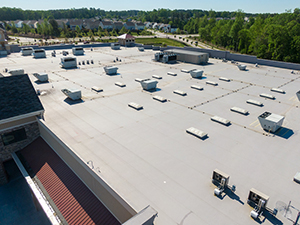
Brewery and food production buildings in Kalamazoo, MI, have roofing problems that a standard commercial roof replacement contractor is not set up to handle. Between the ventilation penetrations, the humidity, and the sanitation requirements, these facilities need a contractor who actually understands what is happening inside the building.
At JM Roofing Solutions, we work on production facilities across Michigan. Call us at (269) 361-8305 to schedule a roof assessment.
This article covers what makes a roof replacement on a Kalamazoo brewery or food production building different from a standard commercial job and why getting those details right matters for the building’s performance long after the crew leaves.
Commercial Roof Replacement: Food Production Buildings
A working brewery or food plant is not an office building with a flat roof. These facilities push steam, heat, and humidity through the roof assembly continuously during production runs. On an aging membrane that has already lost flexibility, that thermal load accelerates deterioration from the inside out. By the time a building owner sees a leak, the insulation beneath the membrane has often been compromised for months.
The replacement process itself also carries risks that general contractors underestimate. Exposing a production facility’s deck during a tear-off is not like exposing a warehouse. Contamination from debris, dust, or moisture during the deck phase can trigger sanitation shutdowns that cost far more than the roofing contract. A contractor who has never worked on a food use building will not plan around this. One who has will schedule the work in phases, protect access points, and communicate with the facility manager before anything gets torn off.
Where Commercial Roof Replacements Fail on Food Production Buildings
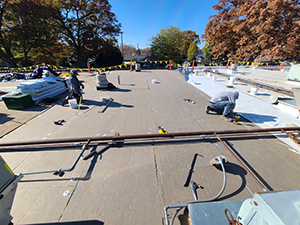
Breweries and food facilities have more roof penetrations per square foot than almost any other building type. Exhaust fans, steam vents, makeup air units, and refrigeration equipment all punch through the membrane, and every one of those points needs to be detailed correctly during a replacement. Flashing failures at penetrations are the most common source of callbacks on production facility roofs, and they almost always trace back to a contractor who treated the detailing as a secondary task rather than a primary one.
The right approach on these buildings includes surveying every penetration before the replacement begins, specifying flashing details for each one, and inspecting each finished detail before the next phase of work starts. It adds time. It also means the roof does not leak at the exact points where moisture infiltration does the most damage.
Insulation Decisions During a Commercial Roof Replacement
Insulation selection during a replacement is not a spec sheet decision on a brewery or food plant. These buildings generate internal humidity levels that drive moisture into the roof assembly if the vapor retarder is undersized or improperly placed. Getting the insulation assembly right during replacement means matching the retarder placement to the building’s actual humidity profile, not installing a standard commercial assembly and moving on.
Single-ply systems like TPO and PVC are both viable on production facilities, but the membrane choice should account for chemical exposure from cleaning agents and exhaust content. PVC holds up better in environments with grease or chemical vapor exposure. A contractor proposing the same membrane for a brewery as they would for a strip mall is not thinking about the building.
Commercial Roof Replacement Requires the Right Contractor
Breweries and food manufacturers in Kalamazoo, MI invest too much in their facilities to hand a roof replacement to a contractor who treats every building the same. At JM Roofing Solutions, we assess each building on its own terms and specify replacements that hold up to what happens inside. Call us at (269) 361-8305 and let us take a look at what your production facility actually needs.
FAQ
Can a commercial roof replacement be completed on a building that cannot shut down?
Yes, large production roofs can be replaced in sections, which allows operations to continue while limiting the area of exposed deck at any one time.
Does a brewery’s internal humidity affect how long a new commercial roof membrane lasts?
It can be if the vapor retarder is not specified correctly for the building’s humidity load during the replacement.
What roof works best on a food production building in Michigan?
PVC tends to outperform TPO in facilities with grease vapor or chemical cleaning exposure, though the right choice depends on the specific facility.
How long does a commercial roof replacement take on a large production building?
Most large single-story production facilities run one to two weeks depending on roof complexity, penetration count, and weather windows.