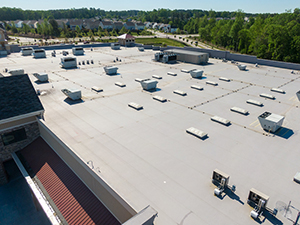
Commercial roof replacement in Kalamazoo, MI requires extra planning when a brewery or food production facility must keep operating during the project. Internal humidity, rooftop exhaust, frequent penetrations, sanitation controls, and production schedules can all affect whether the existing roof can be repaired, whether replacement is justified, and how the work should be phased.
JM Roofing Solutions serves commercial and industrial properties in Michigan, including Kalamazoo. Before authorizing replacement, an owner should be able to see why the existing roof no longer supports a reasonable repair or restoration scope, what materials will be removed or retained, how moisture and deck conditions will be handled, and how the facility will stay protected while work is underway.
What to Confirm Before Authorizing Replacement
Roof age alone does not decide the project. The replacement decision should connect inspection findings to the extent of damage, moisture, insulation condition, deck condition, drainage, and the pattern of prior repairs.
| What is checked | May still support repair | Supports broader replacement evaluation |
|---|---|---|
| Extent of damage | One or more defined defects with surrounding roofing that remains serviceable | Repeated failures across several roof areas or deterioration that is no longer isolated |
| Insulation and moisture | Affected material can be clearly limited and removed within a repair scope | Widespread wet insulation, uncertain moisture boundaries, or conditions that require opening larger areas |
| Deck condition | Decking in and around the repair area remains serviceable | Deterioration, deflection, or other deck conditions require broader corrective work |
| Repair history | Previous repairs remain stable and new problems are isolated | New failures keep appearing across the roof or repair intervals are becoming shorter |
Recover or Tear-Off?
If replacement is justified, the next question is whether any existing roof materials can remain or whether the project requires a full tear-off. That decision depends on actual roof construction, moisture, deck condition, the number of existing roof layers, code requirements, insurer requirements, and the selected replacement assembly.
| Factor | May support retaining existing materials | May require tear-off or broader removal |
|---|---|---|
| Existing insulation | Materials that will remain are dry, serviceable, and suitable for the proposed assembly | Wet or deteriorated insulation needs removal or the moisture boundary cannot be defined confidently |
| Deck condition | Available evidence supports a serviceable deck and the assembly can be installed as designed | Deck condition is damaged, uncertain, or requires direct access for repair |
| Existing roof layers | The proposed assembly is allowed over the existing construction after project-specific review | Layer count, code, system requirements, or insurer requirements prevent another recover |
| Production and sanitation planning | The scope limits exposure and can be sequenced around facility operations | Required removal creates larger deck exposure that needs a detailed containment and sequencing plan |
The written proposal should state what the contractor is assuming about existing layers, insulation, and deck condition. It should also explain how additional wet material or damaged decking discovered during the work will be documented, priced, and authorized before the scope expands.
Penetration Detailing on Food Production Buildings
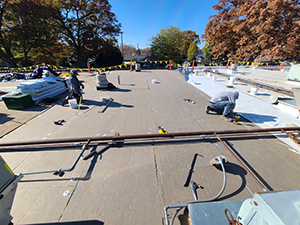
Breweries and food production facilities can have numerous exhaust fans, vents, refrigeration connections, curbs, and other rooftop penetrations. Each transition should be included in the replacement scope. Before work begins, identify penetrations that remain or will be removed and the flashing approach for each condition. Closeout should verify the completed transitions for future inspection and service.
Insulation, Humidity, and Assembly Design
Internal humidity can affect how moisture moves through a roof assembly, but the correct insulation and vapor-control approach cannot be determined from building type alone. The contractor should review the existing assembly, interior conditions, moisture evidence, and requirements for the proposed roof system before deciding which materials remain and how the replacement assembly should be configured.
The replacement proposal should identify the insulation work included and avoid treating one standard assembly as automatically suitable for every production building.
Keeping an Occupied Facility Operating During Replacement
A replacement plan for an operating food or beverage facility should address access, debris control, weather protection, rooftop equipment, production schedules, and the amount of roof opened at one time. Phased work can reduce the area exposed during construction, but the practical sequence depends on roof layout, facility operations, weather, crew access, and the replacement scope.
The contractor should explain how the roof will be protected at the end of each work period, how weather changes the sequence, and how facility staff will be notified before work affects access, equipment, or production areas. Closeout should include the approved scope, authorized changes, relevant documentation, and an acceptance process appropriate to the project.
Commercial Roof Replacement in Kalamazoo, MI
A useful replacement decision connects roof-condition evidence with a written project plan. Before authorizing the work, confirm why repair or restoration is no longer appropriate, whether existing materials can remain, how deck and insulation discoveries will be handled, how penetrations will be detailed, and how the facility will stay protected during construction.
JM Roofing Solutions provides commercial roof replacement in Michigan. Owners can review the company’s replacement guidance for Lansing or its commercial roofing services in Kalamazoo for related service context. Contact JM Roofing Solutions at (833) 466-5325 to discuss a Kalamazoo facility.
Frequently Asked Questions
Can commercial roof replacement be phased around an operating production facility?
Often, yes. The practical sequence depends on roof layout, facility operations, weather, access, and how much of the existing roof must be removed at one time.
Does internal humidity affect commercial roof replacement planning?
It can. Interior conditions, existing moisture, insulation, and vapor-control requirements should be evaluated as part of the complete roof assembly rather than assumed from the building type alone.
What should a replacement quote include for a food production building?
It should identify removal or retained materials, deck and insulation assumptions, allowances for discovered conditions, penetration and flashing details, access and weather planning, sequencing, exclusions, and closeout documentation.
How do I know whether the roof should be repaired or replaced?
Replacement is easier to justify when deterioration, moisture, deck problems, or recurring failures are widespread rather than isolated. The decision should follow inspection evidence and the condition of surrounding materials.