
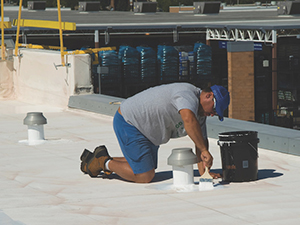
A ceiling stain is not where the leak is. It is where the water ended up. That distinction matters more than most commercial building owners realize, and it is the reason smart roof leak detection starts on the roof, not below it. At JM Roofing Solutions, we locate and repair commercial roof leaks across Michigan, and the approach we use is systematic, not guesswork. Call us at (269) 361-8305 if your building has signs of a leak and you want it found correctly the first time.
Water that enters a roof membrane travels. It moves along insulation layers, follows the deck slope, and pools wherever gravity takes it before showing up inside. In Michigan, snowmelt and heavy spring rain can push that travel distance far from the original entry point. Chasing the ceiling stain leads to the wrong repair. Starting at the roof surface and working systematically leads to the right one.
Roof Leak Detection Tips That Work
Effective leak detection on a commercial roof follows a sequence. Start with the surface during or shortly after a rain event if it is safe to do so. Active water movement on a flat roof shows you where drainage is failing and where pooling is occurring. Both are clues to where the membrane is being stressed most.
After the surface check, move to the interior. Check the attic or ceiling plenum with a light in dark conditions. Active drips trace upward to wet insulation, and wet insulation above a deck tells you roughly where the entry point is above. Note every wet area on a simple sketch of the roof plan. Multiple wet areas that form a line often point to a single seam or flashing failure above them.
Where Roof Leak Detection Should Focus First
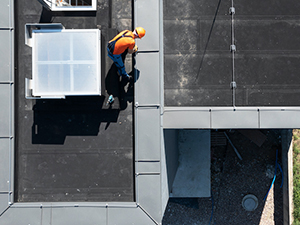
Flashings and penetrations account for the majority of active leaks on commercial roofs. Any point where the membrane meets a vertical surface, a pipe, an HVAC curb, or a parapet wall is a potential entry point. These are the first areas to inspect closely during leak detection because they see the most movement stress and are where adhesive and sealant failures develop first.
After flashings, check every seam on the roof. Run a fingernail along lap edges and probe for any give or separation. A seam that has released is letting water in even if the surface looks intact. On Michigan commercial roofs, seam adhesive fatigue is a common failure mode that visual inspection alone misses.
Roof Leak Detection Tools That Find What Eyes Miss
Professional roof leak detection goes beyond visual inspection. Two tools change what is detectable on a commercial roof. Infrared thermography scans for temperature differentials that indicate wet insulation beneath the membrane. Wet insulation holds heat differently than dry, and an infrared scan maps those differences across the entire roof in one pass.
Electronic leak detection uses low-voltage or high-voltage testing to find membrane breaches with no visible surface damage. A circuit runs between the membrane and deck, and any breach creates a detectable signal. For pinhole breaches or micro-cracks, these tools find what visual checks miss entirely.
What to Do After Leak Detection Finds the Source
Once the source is confirmed, the repair approach depends on what caused the leak. Here is how the most common findings translate into action:
- Flashing separation at a wall or curb: reseal the termination and apply reinforcing membrane over the affected area.
- Seam lap failure: clean the area, apply lap sealant, and re-weld or tape the seam depending on membrane type.
- Membrane puncture or crack: clean, prime if needed, and apply a compatible patch cut to extend at least six inches beyond the damaged area.
- Drain blockage causing ponding stress: clear the drain, inspect the membrane around the drain ring, and repair any surface damage before the next rain event.
Document every repair with photos and note the location on a roof plan. That record becomes the baseline for future inspections and helps track any area showing recurring problems.
Roof Leak Detection Professionals
Guessing at a leak wastes time and leaves the actual problem untouched. At JM Roofing Solutions, we use systematic roof leak detection to find the source correctly on commercial buildings across Kalamazoo, MI. Call us at (269) 361-8305 and we will locate the leak and walk you through what the repair involves.
FAQ
Why does my ceiling leak in one spot, but the roof looks fine above it?
Water travels along insulation and decking before dripping through, so the leak entry point is often several feet from where the stain appears inside.
Can I find a roof leak myself or do I need a contractor?
Surface checks at flashings and seams are doable for building owners, but pinhole breaches and subsurface moisture require professional tools like infrared scanning to locate reliably.
How long does a professional roof leak detection inspection take?
A standard visual and probe inspection on a commercial roof typically takes one to three hours depending on roof size and complexity.
What causes most commercial roof leaks in Michigan?
Flashing separation and seam adhesive failure from freeze-thaw cycling are the most common sources, followed by drain blockage and ponding damage.