Two contractors can each propose TPO roofing for the same building and be talking about products that perform very differently over time. The category name is the same, but what is in the membrane is not. Building owners who do not understand these differences end up making decisions based on price alone, which is how a lot of Michigan commercial roofs underperform their expected lifespan.
At JM Roofing Solutions, we install TPO and single-ply systems on commercial buildings across Jackson, MI. Call us at (269) 361-8305 and we will show you exactly what you are being proposed and why it matters.
How TPO Roofing Membranes Vary in Quality
TPO stands for thermoplastic polyolefin, but that name covers a range of formulations that vary significantly in polymer quality, scrim reinforcement, and thickness consistency. The membrane that comes off a reputable manufacturer’s line and the membrane produced at the lowest cost point are both called TPO. They do not perform the same way under Michigan freeze-thaw cycling, UV exposure, and thermal movement stress.
The industry has no single universal TPO standard that every manufacturer must meet. There are ASTM performance standards that provide a baseline, but they test to minimum thresholds, not real-world durability benchmarks. A membrane that passes minimum testing can still be a poor long-term performer on a Jackson commercial building if the formulation uses lower-grade polymers, inconsistent scrim placement, or inadequate topcoat thickness. Knowing what separates a quality TPO membrane from a commodity one is how you avoid finding out the hard way.
Membrane Thickness Within TPO Roofing
TPO membranes are sold in 45-mil, 60-mil, and 80-mil nominal thicknesses. That number refers to the total membrane thickness, but what matters most is the thickness of the top ply above the reinforcing scrim. The scrim layer does not contribute to weathering resistance. Only the material above it does.
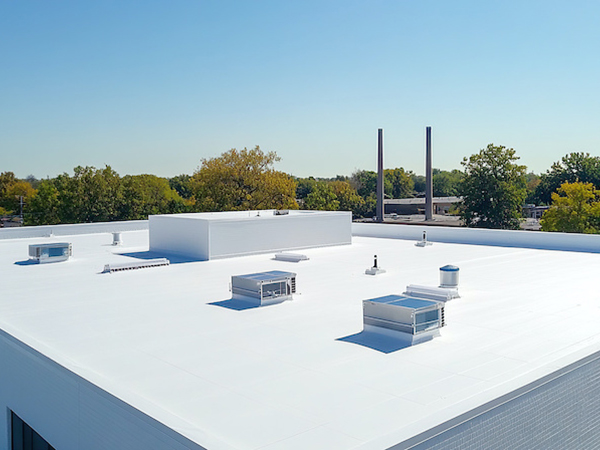
A low-cost 60-mil TPO can have a top ply as thin as 10 to 12 mils above the scrim, while a quality 60-mil product may carry 20 mils or more above the scrim. The difference is invisible when you look at the rolled membrane, but it shows up clearly in how the surface holds up to foot traffic, UV degradation, and the repeated thermal movement that Michigan’s temperature swings put every roof through. When comparing bids, ask each contractor to specify the manufacturer, product name, and the top-ply thickness above the scrim. Any contractor who cannot answer that question is not specifying the system carefully enough.
Seam Quality Is Where TPO Roofing Holds
The heat-welded seam is the defining performance feature of a TPO system. Done correctly, a hot-air welded TPO seam is stronger than the membrane itself. Done poorly or with an inferior membrane, it is the first place the roof fails. Seam quality depends on two things: the membrane formulation and the installation technique.
Some lower-grade TPO membranes have inconsistent polymer blends that make the seam weld brittle over time rather than remaining flexible as the roof moves with temperature changes. A weld that cures brittle will develop micro-cracks along its edge within a few years of installation, particularly at corners, curbs, and anywhere the membrane experiences concentrated movement. Michigan winters accelerate that cracking because cold temperatures stress brittle weld lines most aggressively. This is one of the clearest reasons why membrane formulation and manufacturer reputation matter beyond just the thickness specification.
What to Look for When Comparing TPO Roof Proposals
Evaluating competing TPO proposals requires more than comparing the per-square footage number. These are the specification details worth verifying before signing any contract:
- Manufacturer name and specific product line, not just the membrane thickness
- Top-ply thickness above the scrim, which determines actual weathering surface depth
- Whether the product carries an FM or UL uplift rating appropriate for the building’s wind zone
- Warranty terms from the manufacturer, including whether it covers both materials and labor and what the non-prorated coverage period is
TPO Roofing Experts
TPO roofing is one of the best commercial membrane options for Michigan buildings when specified and installed correctly. The difference between a well-specified system and a commodity installation shows up in years of service life.
JM Roofing Solutions works with commercial building owners across Jackson, MI, to match the right TPO system to each building’s specific demands. Call us at (269) 361-8305 for a free inspection and a proposal that tells you exactly what you are getting.
FAQ
What TPO roofing thickness is best for a Michigan commercial building?
60-mil is the practical standard for most commercial applications, with 80-mil appropriate for buildings with regular rooftop equipment access.
How long should a TPO roof last in Michigan?
A quality TPO system installed correctly should deliver 20 to 30 years under Michigan conditions, though membrane grade and installation quality drive the actual outcome.
Can TPO roofing be repaired if a seam opens?
Yes, open seams can be re-welded or patched with compatible TPO material, but recurring seam failures usually signal a membrane or installation quality problem worth addressing at the root.
Does TPO roofing color affect performance?
White TPO reflects the most solar energy and performs best for cooling load reduction in Michigan summers. Gray and tan are available but carry a higher surface temperature under direct sun.